Arizona Gold Prospecting
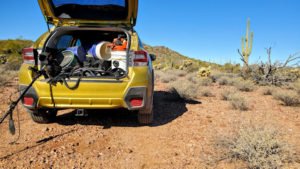
Arizona Gold Prospecting – Vulture Mine Road area near Wickenburg, AZ today.

Beautiful day, temperatures in the low 80s. A couple of hours of detecting with the GPS 5000 just turned up all sorts of trash. (more…)
gold metal detecting
Arizona Gold Prospecting – Vulture Mine Road area near Wickenburg, AZ today.

Beautiful day, temperatures in the low 80s. A couple of hours of detecting with the GPS 5000 just turned up all sorts of trash. (more…)
This is one of my archived videos about gold metal detecting. But, although the video is a number of years old oh, the basic concepts that I talked about are still very relevant today.
I’ve been into gold detecting for many years. On many detecting trips that’s all I find is what’s pictured here in this video and that’s trash. But, when you do find that little gold nugget, it kind of makes up for all the times you just find trash. (more…)
Plenty of gold still out in Arizona.
The perfect combination went out gold prospecting – – a good dry washer and metal detector. Yes, they really go together to help find the small gold that’s typical in a lot of the Arizona gold prospecting areas. (more…)
Bumble Bee/Cleator Arizona area with Gold Monster and finding small Gold Nuggets!
From Wikipedia, the free encyclopedia:
Established in 1863, Bumble Bee served as a stagecoach stop and an outpost for the U.S. Cavalry, with a post office established in 1879. The creek, and by extension the town, were so named because early travelers in the area claimed that the indigenous people there were as “thick as bumblebees”. (more…)
Metal detecting volcanic gold nuggets on the island of Papua New Guinea.
Up until 1970, there was little mineral extraction in Papua New Guinea. Since the 1970s, mineral extraction has dominated the national economy. With the exception of the Ok Tedy Mine (copper-gold) almost all of the mining in PNG has been gold mining. (more…)
Huge gold nuggets found metal detecting. A deadly snake falls into the hole where the Victoria Diggers are prospecting for gold, setting off a panicked attempt of relocating the snake whilst trying not to get bitten.
From Wikipedia, the free encyclopedia:
On 1 July 1851 Victoria became a separate colony and, on the same day, James Esmond in company with Pugh, Burns and Kelly, found alluvial gold in payable quantities near Donald Cameron’s station on Creswick’s Creek, a tributary of the Loddon, at Clunes, 34 km (22m) north of Ballarat. Esmond and his party found the gold after Esmond had been told by George Hermann Bruhn of the gold that had been found in March 1850 on Cameron’s property at Clunes and that in the vicinity were quartz reefs which were likely to bear gold.[60] Esmond rode into Geelong with a sample of their discovery on 5 July. News of the discovery was published first in the Geelong Advertiser on 7 July and then in Melbourne on 8 July. (more…)
New detecting areas are always intriguing and this spot proves itself on day one. Not only are there gold nuggets in the creeks but also on the vast flats. The best gold find though is a big specimen that looks like chocolate and gold.
Gold nuggets in the Australian outback. (more…)
The Gold Gypsies are on the move believing a new 200-hectare lease will answer their prayers. When prospecting on their new lease for the first time, they hit the jackpot with an incredible 3-ounce nugget worth around $5000!
From Wikipedia, the free encyclopedia:
The Victorian gold rush was a period in the history of Victoria, Australia approximately between 1851 and the late 1860s. It led to a period of extreme prosperity for the Australian colony, and an influx of population growth and financial capital for Melbourne, which was dubbed “Marvellous Melbourne” as a result of the procurement of wealth. (more…)
In the video’s its just about capturing the events that unfold on our journey through our gold detecting, and the best part about that is we just never know what the day will bring.
Certainly we get excitement just from being out there. But the joys of finding gold no matter what the size is something we just never get back and need to share these moment. (more…)
This nugget took over an hour to dig and chisel out. It was 10″ deep in caliche. Caliche is a cemented conglomerate sort of rock very common in the desert southwest.
The metal detector used in the video is a Minelab GPZ7000. At this time this detector is the flagship gold detector in the entire Minelab line of detectors & cost about $8,000!
Checking our an open gold mining claim off N. Hot Springs Road, Arizona.
The gold prospecting areas around Wickenburg and Morristown are still very productive.
My buddy, who was using a recirculating high banker, did find some color, but not enough to make it worthwhile to revisit this site. (more…)
Morristown, Az off of Castle Hot Springs Road
No, in real life you do not find gold on most metal detecting outings. But, it is important to stay with it, to insure that on one of your outings, your luck will turn. (more…)
Thinking about upgrading your search coil? Are you unsure of whether to buy the 15″ round or the 17×13″ elliptical. They are both good coils, but with some very slight differences, so I decided to do a video so you can see for yourself. On the two targets tested, the 5000 with 15″ round in Fine Gold gave the best response, and a very close second was the 17×13″ in Enhance on the 4500. (more…)
We found an area in the Pilbara that has never seen a metal detector before! We just arrived in a new spot and expected having to prospect for several days before getting to a good spot but we found it after only two kilometers of walking on the first day. Screaming targets in a remote gully revealed plenty of chunky gold nuggets (and also a few bullet casings). (more…)
As I recall, Minelab’s Newest Gold Machine the GPZ 7000 came out in 2015 for about $10,000. Currently, this gold detector selling new for about $7,999.
This detector is the next flagship gold detector based on new ZVT technology that developed by Minelab that will dramatically improve detector performance beyond all other gold detectors. (more…)
Some facts about us and the island: Based on local folklore, the island is pretty much just a big active volcano that last erupted some 470 years ago. This is a fact and verified based on historical records. (more…)
Victorian golden triangle dream gold nugget find.
From Wikipedia, the free encyclopedia:.
The first gold rush in Australia began in May 1851 after prospector Edward Hargraves claimed to have discovered payable gold near Orange, at a site he called Ophir. Hargraves had been to the Californian goldfields and had learned new gold prospecting techniques such as panning and cradling. Hargraves was offered rewards by the Colony of New South Wales and the Colony of Victoria. Before the end of the year, the gold rush had spread to many other parts of the state where gold had been found, not just to the west, but also to the south and north of Sydney. (more…)
There is nothing like finding a gold nugget, especially a large gold nugget! (more…)
Some facts about us and the island: Based on local folklore, the island is pretty much just a big active volcano that last erupted some 470 years ago. This is a fact and verified based on historical records.